A practical guide for bidders in hyper-competitive oilfield services markets.
In the world of oilfield services tenders, attention usually focuses on visible mistakes: an inflated price, a missing document, a missed deadline. But there is a more dangerous category of mistakes — the ones nobody notices during preparation, the ones that appear on the surface to be “normal” or even “wise” behaviors, and which you later discover were the real reason you lost the tender. These mistakes are like the boiling frog: you don't feel them as they accumulate, until you suddenly find yourself out of the competition.
But there is a second layer to this problem that most articles ignore. In competitive markets, where clients dictate target prices and dozens of service companies compete for the same scope, the traditional advice of “price to profit, not to win” becomes almost meaningless. You don't control the price. You either accept the target or you walk away. And for most service companies, walking away is not an option.
So this article addresses two categories of mistakes: the ones that lose you the tender, and the ones that lose you the profit after you win it.
Part one: the mistakes that lose you the tender
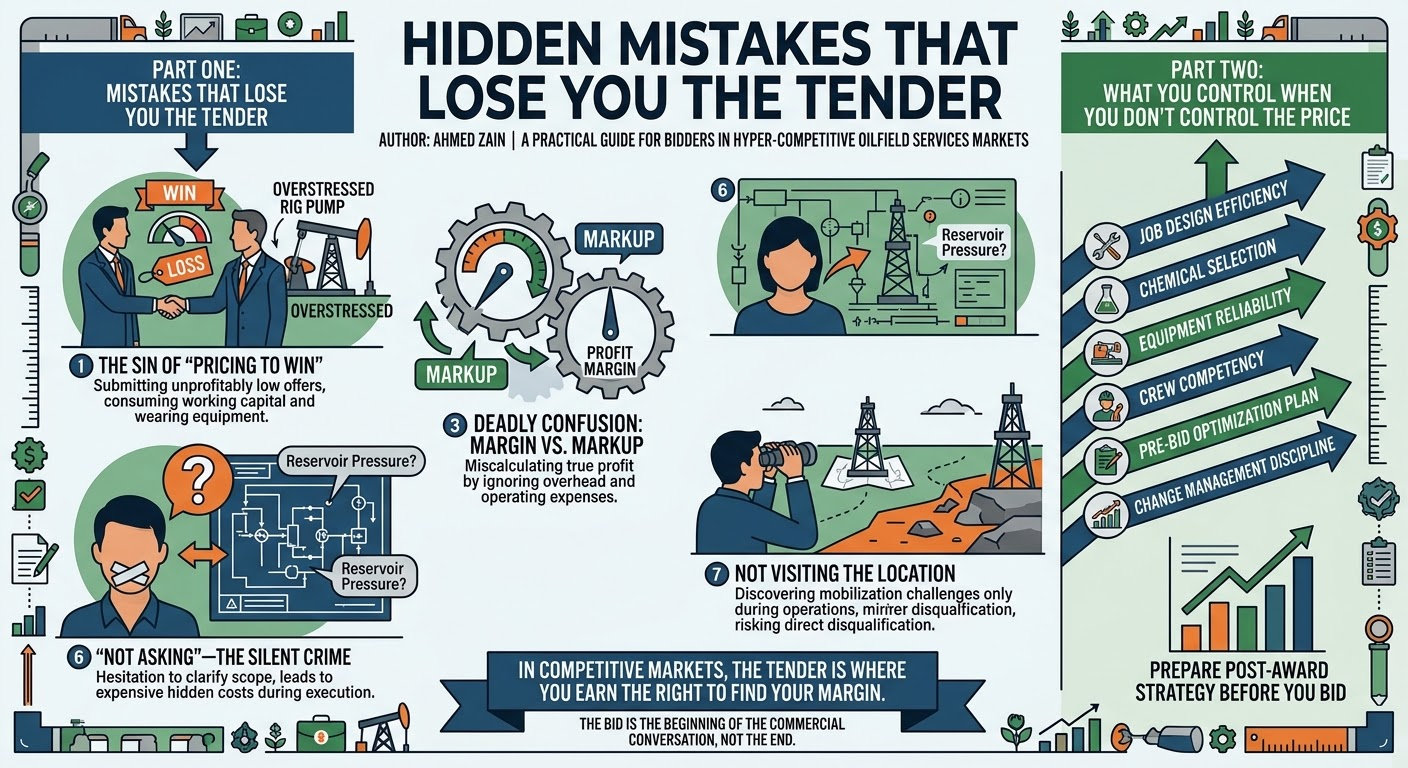
First: the sin of “pricing to win” instead of “pricing to profit”
This fundamental mistake begins with a hidden intention: “I must win this tender, so I'll lower the price a little.” But that “little” turns into a whole pattern of pricing. Service companies that price from a position of weakness, assuming the client holds all the bargaining power, end up submitting offers that don't reflect the true cost of execution.
The result? You may win the tender, but you lose the job. Net profit margins in oilfield services are already thin, and most upstream services are among the most operationally intensive and unforgiving service lines. When you shave your margin “a little” to win, you are not just sacrificing profit — you are consuming working capital, wearing out your equipment faster than your revenue can replace it, and putting your crews under unjustified pressure. Worse still, the jobs you “win” this way are often the ones that cost you more than all the others.
Second: the target price trap, when you have no choice but to accept
In hyper-competitive markets, the client may set a target price, and the competitive dynamic shifts entirely. It is no longer “who can price lowest”. It is “who can accept the target price and still find ways to be profitable”.
This is where the most dangerous hidden mistake occurs: accepting the target price without a post-award profit plan.
The mistake is not accepting the target price — in many cases you have no choice. The mistake is treating the award as the finish line, rather than the starting point of a second, equally important commercial phase.
In most upstream services, once the job starts, external levers are limited. The pumping schedule is set. The chemicals are on location. The crew is on the clock. Internal cost control — how you mobilize, how you mix, how you stage equipment, how you manage standby time — becomes the primary driver of job profitability. Profitability becomes a function of execution efficiency rather than contract structure alone. The service companies that survive in these environments are the ones that prepare their post-award strategy before they submit their bid.
Third: the deadly confusion between “profit margin” and “markup”
Many service companies confuse the two terms without realizing it. Markup is what you add to the direct cost (for example, 20% on 100,000 = 120,000). Profit margin is what actually remains after covering all costs, including administrative and operating expenses.
The hidden mistake is believing that a 30% markup means a 30% profit. In reality, after accounting for indirect expenses, taxes and retainage, you may be left with 5% or less. This misunderstanding leads to offers that look profitable on paper but are in fact built on sand.
Fourth: ignoring indirect overhead expenses
Overhead, insurance, administration, equipment maintenance, even your own salary, are real numbers. Failing to include them in every line item of the offer makes the job appear cheaper than it is. The mistake here isn't “ignoring” in the literal sense, but pricing items on direct cost alone, without calculating each item's share of the overhead.
In oilfield services, the overhead problem is even more acute than in general contracting. Your equipment, your tools, your accessories — these assets sit idle between jobs, but their depreciation, certification and maintenance costs don't stop. If your pricing doesn't capture the true cost of asset readiness, you are subsidizing the client's operation with your own capital.
Less successful service companies add a flat percentage to cover administrative expenses, while more successful ones price accurately and put the number in the right place — per job, per zone, per stage. The difference isn't in economizing but in precision.
And this precision does not come from a spreadsheet template. It comes from qualified, skilled and well-seasoned technical expertise: engineers and operations professionals who have executed these jobs before, who know what a coiled tubing run actually costs when the reel is on location, who understand what a cementing stage truly consumes in chemicals, additives and standby time, and who can translate past execution experience into accurate cost allocation. Without that expertise, overhead allocation becomes guesswork. With it, every line item carries the weight it should — no more, no less.
Fifth: the “small” calculation errors that turn profit into loss
This is a mistake everyone knows about in theory, but nobody admits to making. Studies indicate that calculation errors continue to occur despite the use of calculators and software. More dangerous still, adjusting prices at the last minute — a common behavior — can cause simple formula or calculation errors that quickly turn a profitable job into a loss.
In upstream services, the margin for error is even smaller. A misplaced decimal in chemical volume, a wrong barrel-to-gallon conversion or an incorrect pump rate assumption can mean the difference between a profitable stage and a loss-making one. The problem isn't the existence of an error, but the absence of an independent review. Who reviews your offer before submission? If the answer is “me, myself”, then you are not reviewing — you are looking at the same numbers again with the same eyes.
Sixth: “not asking” — the silent crime
In tenders there is an unwritten rule: every question you hesitate to ask will cost you double what you expected. Not asking questions during the clarification stage isn't a sign of confidence; it's a sign of arrogance or haste.
In oilfield services, the questions that go unasked are often the most expensive:
- What is the actual bottomhole temperature and pressure?
- What is the fluid compatibility with the formation?
- What is the hole geometry and completion type?
- What is the expected pump rate and surface pressure?
- What are the contingency requirements if the primary plan fails?
- What is the standby rate, and when does it apply?
Mistakes in understanding the scope of work, in interpreting specifications, or in unstated assumptions all begin with hesitation to ask. Tendering entities want offers that understand the job. When you ask, you are not showing ignorance — you are showing that you take the job seriously.
Seventh: not visiting the location — “I'll understand from the program”
This mistake in particular only shows its effect during execution. Visiting the location or the client's yard before submission isn't optional or a courtesy. What you see on paper differs from what you find on the ground: rig floor access, crane capacity, chemical storage space, water supply, power availability, road conditions and the proximity of your nearest base.
In upstream services, mobilization logistics can make or break a job. If you assume you can spot equipment and tools on location without checking access routes and pad space, you may find yourself demobilizing before you even rig up. In some tenders, attending the pre-submission meeting or site visit is mandatory, and your absence means your offer is disqualified outright.
Eighth: “we'll review the offer at the end” — the unforgivable haste
A tender prepared in one day is, at best, 80% complete. The remaining 20% — signatures, mandatory attachments, incomplete schedules, discrepancies between numbers — is often overlooked, and it is what eliminates you.
Haste isn't limited to starting late; it also includes “imagined” haste: starting early but leaving the final review to the last hour. In that hour you can't see the mistake, because your brain “knows” what you wrote, so it reads what you want rather than what is actually there.
Ninth: no post-award profit strategy
This is the mistake that replaces the traditional “know when to walk away” advice in target-price markets. When you cannot walk away, the mistake becomes treating the award as the end of the commercial conversation.
The revised approach requires three post-award levers, prepared before you bid.
1. Cost optimization as a pre-planned discipline. This is not about cutting costs later. It is about having a modular, repeatable cost model ready before the bid. In upstream services, this means:
- Job design optimization: pre-engineered fluid systems, standardized chemical packages and repeatable pumping schedules that reduce engineering time and on-site improvisation.
- Mobilization efficiency: pre-planned equipment packages, optimized crew sizes and route planning that reduce non-productive time.
- Chemical and material management: bulk purchasing agreements, pre-mixed systems where applicable, and less waste through precise volume calculations.
- Equipment utilization: scheduling multiple jobs in the same area to reduce mobilization costs, and planning maintenance windows around job schedules rather than in response to breakdowns.
Lean scoping and standardized job design can deliver significantly more gross profit than fully customized, one-off job plans. The key is having this system in place before you accept the target price, not scrambling to build it afterwards.
2. Pre-identified upsell points (value gaps). Before bidding, the commercial and technical teams should map every predictable gap between what the tender requires and what the client will actually need for a successful operation. In upstream services, these typically include:
- Clarifications that become scope: additional runs, contingency stages, alternative systems, additional techniques, post-job cleanout runs and diagnostic runs.
- Job design upgrades: real-time telemetry, new technologies, advanced diversion techniques and engineered spacer systems.
- Supply chain alternatives: alternate chemical suppliers, local sourcing to meet ICV requirements where applicable, and revised formulations that maintain performance at lower cost.
- Post-job and integrity packages: post-job cleanup, wellbore integrity assessment and production enhancement recommendations.
- Standby and contingency services: extended standby coverage, additional equipment on location and rapid response provisions.
The mistake is not having these identified and priced as options before you win. If you discover them after award, you are negotiating from weakness. If you present them as pre-planned value propositions, you are monetizing your operational insight.
3. Change orders as a service, not a fight. In target-price environments, change orders become the primary margin recovery mechanism. In oilfield services they are frequent and often legitimate: additional stages, unexpected downhole conditions, extended standby, additional runs and scope changes requested by the client's engineers.
The mature approach involves early notice, quantified impact, options and documented approvals. This protects relationships and improves cash-flow discipline. Service companies that priced low, won the job and then industrialized their variation order process are the ones who recover the margin they knew they would never make on the base scope.
Tenth: not learning from previous offers
When you lose a tender, do you know why? Most companies don't. Studies indicate that 11% of successful offers and 15% of failed offers have unknown reasons for their success or failure. This isn't just a lack of transparency from the tendering entity; it is also a shortcoming on the bidder's part in seeking feedback and analyzing results.
In oilfield services this is particularly damaging, because the same clients tender the same services repeatedly. If you don't know why you lost the last coiled tubing tender, you will make the same mistake in the next one. The hidden mistake is always attributing failure to price when the real reason lies elsewhere: technical evaluation, HSE record, equipment certification, crew competency or a formal error.
Eleventh: negotiating with yourself before negotiating with the client
This is a hidden psychological mistake. Before submitting the offer, questions run through your head: “Is this price too high?” “What if my competitor offers less?” So you start lowering your numbers without objective reason, anticipating the client's reaction. You are negotiating with yourself on behalf of the other party.
The mistake isn't well-studied competitive pricing, but reactive pricing against an imaginary threat. The client hasn't said your price is high yet. You have only assumed they will.
Part two: what you control when you don't control the price
This is the most important section for bidders in competitive markets like ADNOC. It draws a clear line between what is outside your control and what is not.
Variables you do not control:
- The base tender price
- The client's target price
- The number of competitors
- The evaluation criteria
- The award timeline
- The reservoir conditions
- The well program
Variables you do control:
- Job design efficiency
- Chemical selection and concentration
- Equipment readiness and reliability
- Crew competency and experience
- Mobilization and logistics planning
- Internal cost controls
- The quality and timing of your value-add proposals
- Your change management discipline
- Your pre-bid preparation for post-award optimization
- Your HSE performance and its impact on future evaluations
The core argument is simple: in hyper-competitive target-price markets, your bid team and your operations team must be the same conversation. The people who will execute the job must be involved in the decision to accept the target price, because they are the ones who will have to find the margin.
If your commercial team accepts a target price without input from your operations team, you have already lost the job before you won it. If your operations team has no pre-planned cost optimization levers and no mapped upsell opportunities, you are entering execution with no commercial strategy.
How do you avoid these mistakes?
The cure begins with acknowledging that most of these mistakes aren't ignorance but deeply entrenched institutional behaviors. You know independent review is essential, but you don't do it because time is tight. You know asking is important, but you don't ask for fear of appearing incompetent. You know post-award profitability requires planning, but you leave it until after the award.
The radical solution has three parts:
- Separate the preparer from the reviewer. They cannot be the same person at the critical moments. Establish a mandatory checklist for every tender, reviewed at least a full hour before submission.
- Build your post-award strategy before you bid. Cost optimization models, upsell maps and change management processes should be ready before you accept the target price. Not after.
- Institutionalize the learning loop. After every tender — win or lose — dedicate time to one question: what could we have done differently? And document the answer.
Conclusion
In target-price markets, the tender is not where you win your margin. It is where you earn the right to go and find it.
The service companies that survive and thrive in environments like ADNOC tenders are not the ones that bid lowest. They are the ones that enter every tender with a cost optimization engine, a mapped set of upsell opportunities and a change management process that turns operational insight into commercial value.
A tender is not a price contest. It is a test of your ability to understand the job, price it accurately, present it clearly and — critically — plan for profitability after the award.
The bid is the beginning of the commercial conversation, not the end.
دليل عملي للمتقدّمين بالعطاءات في أسواق خدمات حقول النفط شديدة التنافس.
في عالم مناقصات خدمات حقول النفط، ينصبّ الاهتمام عادةً على الأخطاء الظاهرة: سعر مبالغ فيه، أو مستند ناقص، أو موعد نهائي فائت. لكن هناك فئة أخطر من الأخطاء — تلك التي لا يلاحظها أحد أثناء الإعداد، وتبدو في ظاهرها سلوكيات «طبيعية» بل «حكيمة»، ثم تكتشف لاحقًا أنها كانت السبب الحقيقي لخسارتك المناقصة. هذه الأخطاء أشبه بالضفدع في الماء الذي يسخن ببطء: لا تشعر بها وهي تتراكم، حتى تجد نفسك فجأة خارج المنافسة.
غير أن لهذه المشكلة طبقة ثانية تتجاهلها معظم المقالات. ففي الأسواق التنافسية، حيث يفرض العملاء أسعارًا مستهدفة وتتنافس عشرات شركات الخدمات على النطاق نفسه، تفقد النصيحة التقليدية «سعّر لتربح، لا لتفوز» معناها تقريبًا. أنت لا تتحكم في السعر؛ إما أن تقبل السعر المستهدف أو تنسحب. وبالنسبة لمعظم شركات الخدمات، الانسحاب ليس خيارًا.
لذلك يتناول هذا المقال فئتين من الأخطاء: تلك التي تُفقدك المناقصة، وتلك التي تُفقدك الربح بعد أن تفوز بها.
الجزء الأول: الأخطاء التي تُفقدك المناقصة
أولًا: خطيئة «التسعير للفوز» بدلًا من «التسعير للربح»
يبدأ هذا الخطأ الجوهري بنيّة خفية: «يجب أن أفوز بهذه المناقصة، فلأخفّض السعر قليلًا». لكن هذا «القليل» يتحوّل إلى نمط تسعير كامل. فشركات الخدمات التي تسعّر من موقع ضعف، مفترضةً أن العميل يملك كل أوراق التفاوض، ينتهي بها الأمر إلى تقديم عروض لا تعكس التكلفة الحقيقية للتنفيذ.
والنتيجة؟ قد تفوز بالمناقصة، لكنك تخسر العمل. فهوامش صافي الربح في خدمات حقول النفط ضيقة أصلًا، ومعظم خدمات المنبع من أكثر خطوط الخدمات كثافة تشغيلية وأقلها تسامحًا مع الخطأ. وحين تقتطع من هامشك «قليلًا» لتفوز، فأنت لا تضحّي بالربح فحسب — بل تستهلك رأس المال العامل، وتُنهك معداتك أسرع مما تستطيع إيراداتك تعويضه، وتضع طواقمك تحت ضغط غير مبرر. والأسوأ أن الأعمال التي «تفوز» بها بهذه الطريقة كثيرًا ما تكون الأعلى تكلفةً عليك من بين كل أعمالك.
ثانيًا: فخ السعر المستهدف، حين لا تملك إلا القبول
في الأسواق شديدة التنافس قد يحدد العميل سعرًا مستهدفًا، فتتغيّر ديناميكية المنافسة كليًا؛ لم يعد السؤال «من يقدّم أقل سعر؟» بل «من يستطيع قبول السعر المستهدف ويجد مع ذلك طريقًا إلى الربح؟».
وهنا يقع أخطر الأخطاء الخفية: قبول السعر المستهدف دون خطة للربحية بعد الترسية.
الخطأ ليس في قبول السعر المستهدف — ففي كثير من الحالات لا خيار لك. الخطأ هو التعامل مع الترسية كخط نهاية، لا كنقطة انطلاق لمرحلة تجارية ثانية لا تقل أهمية.
ففي معظم خدمات المنبع، وبمجرد بدء العمل، تصبح الروافع الخارجية محدودة: جدول الضخ محدد، والمواد الكيميائية في الموقع، والطاقم يعمل بالساعة. ويصبح ضبط التكاليف الداخلية — كيف تنقل معداتك، وكيف تخلط، وكيف ترتّب المعدات، وكيف تدير وقت الانتظار — المحرّك الأساسي لربحية العمل. فتغدو الربحية دالة لكفاءة التنفيذ لا لهيكل العقد وحده. وشركات الخدمات التي تصمد في هذه البيئات هي التي تُعد استراتيجية ما بعد الترسية قبل أن تقدّم عطاءها.
ثالثًا: الخلط القاتل بين «هامش الربح» و«نسبة الإضافة»
تخلط شركات خدمات كثيرة بين المصطلحين دون أن تدرك. فنسبة الإضافة هي ما تضيفه إلى التكلفة المباشرة (مثلًا 20% على 100,000 = 120,000)، أما هامش الربح فهو ما يتبقى لك فعلًا بعد تغطية جميع التكاليف، بما فيها المصروفات الإدارية والتشغيلية.
والخطأ الخفي هو الاعتقاد بأن إضافة 30% تعني ربحًا بنسبة 30%. في الواقع، وبعد احتساب المصروفات غير المباشرة والضرائب والمبالغ المحتجزة، قد يتبقى لك 5% أو أقل. ويقود هذا الفهم الخاطئ إلى عروض تبدو مربحة على الورق لكنها مبنية على رمال.
رابعًا: تجاهل المصروفات العامة غير المباشرة
المصروفات العامة والتأمين والإدارة وصيانة المعدات، بل وراتبك أنت، كلها أرقام حقيقية. وعدم إدراجها في كل بند من بنود العرض يُظهر العمل أرخص مما هو عليه. والخطأ هنا ليس «التجاهل» بالمعنى الحرفي، بل تسعير البنود على أساس التكلفة المباشرة وحدها، دون احتساب حصة كل بند من المصروفات العامة.
وفي خدمات حقول النفط تكون مشكلة المصروفات العامة أشد حدة منها في المقاولات العامة؛ فمعداتك وأدواتك وملحقاتك تظل خاملة بين الأعمال، لكن تكاليف إهلاكها واعتمادها وصيانتها لا تتوقف. وإذا لم يعكس تسعيرك التكلفة الحقيقية لجاهزية الأصول، فأنت تدعم عمليات العميل من رأس مالك.
تضيف شركات الخدمات الأقل نجاحًا نسبة ثابتة لتغطية المصروفات الإدارية، بينما تسعّر الشركات الأنجح بدقة وتضع الرقم في مكانه الصحيح — لكل عمل، ولكل منطقة، ولكل مرحلة. والفرق ليس في «التوفير» بل في الدقة.
وهذه الدقة لا تأتي من قالب جداول بيانات، بل من خبرة فنية مؤهلة وماهرة ومتمرّسة: مهندسون ومتخصصو عمليات نفّذوا هذه الأعمال من قبل، ويعرفون التكلفة الفعلية لتشغيل الأنابيب الملفوفة حين تكون البكرة في الموقع، ويدركون ما تستهلكه مرحلة التسميت فعلًا من مواد كيميائية وإضافات ووقت انتظار، ويستطيعون ترجمة خبرة التنفيذ السابقة إلى توزيع دقيق للتكاليف. من دون هذه الخبرة يصبح توزيع المصروفات العامة تخمينًا، ومعها يحمل كل بند وزنه الصحيح — لا أكثر ولا أقل.
خامسًا: أخطاء الحساب «الصغيرة» التي تحوّل الربح إلى خسارة
هذا خطأ يعرفه الجميع نظريًا، لكن لا أحد يعترف بارتكابه. تشير الدراسات إلى أن أخطاء الحساب لا تزال تحدث رغم استخدام الآلات الحاسبة والبرمجيات. والأخطر أن تعديل الأسعار في اللحظة الأخيرة — وهو سلوك شائع — قد يُحدث أخطاء بسيطة في المعادلات أو الحسابات تحوّل عملًا مربحًا إلى خاسر بسرعة.
وفي خدمات المنبع يكون هامش الخطأ أضيق؛ ففاصلة عشرية في غير موضعها في حجم المواد الكيميائية، أو تحويل خاطئ من البرميل إلى الجالون، أو افتراض غير صحيح لمعدل الضخ، قد يصنع الفرق بين مرحلة مربحة وأخرى خاسرة. والمشكلة ليست في وجود الخطأ، بل في غياب المراجعة المستقلة. من يراجع عرضك قبل تقديمه؟ إذا كانت الإجابة «أنا بنفسي»، فأنت لا تراجع — بل تنظر إلى الأرقام نفسها مرة أخرى بالعينين نفسيهما.
سادسًا: «عدم السؤال» — الجريمة الصامتة
في المناقصات قاعدة غير مكتوبة: كل سؤال تتردد في طرحه سيكلّفك ضعف ما توقعت. وعدم طرح الأسئلة في مرحلة الاستيضاح ليس علامة ثقة، بل علامة غرور أو تسرّع.
وفي خدمات حقول النفط، كثيرًا ما تكون الأسئلة التي لا تُطرح هي الأعلى تكلفة:
- ما درجة الحرارة والضغط الفعليان في قاع البئر؟
- ما مدى توافق الموائع مع التكوين؟
- ما الشكل الهندسي للبئر ونوع الإكمال؟
- ما معدل الضخ المتوقع والضغط السطحي؟
- ما متطلبات الطوارئ إذا فشلت الخطة الأساسية؟
- ما سعر الانتظار، ومتى يُطبّق؟
فالأخطاء في فهم نطاق العمل، أو في تفسير المواصفات، أو في الافتراضات غير المعلنة، تبدأ كلها بالتردد في السؤال. والجهات الطارحة للمناقصات تريد عروضًا تفهم العمل؛ وحين تسأل، فأنت لا تُظهر جهلًا — بل تُظهر أنك تأخذ العمل بجدية.
سابعًا: عدم زيارة الموقع — «سأفهم من البرنامج»
هذا الخطأ تحديدًا لا يظهر أثره إلا أثناء التنفيذ. فزيارة الموقع أو ساحة العميل قبل التقديم ليست «اختيارية» ولا «مجاملة»؛ ما تراه على الورق يختلف عما تجده على الأرض: الوصول إلى أرضية الحفار، وسعة الرافعات، ومساحة تخزين المواد الكيميائية، وإمدادات المياه، وتوافر الكهرباء، وحالة الطرق، وقرب أقرب قاعدة لك.
وفي خدمات المنبع، قد تصنع لوجستيات التحريك نجاح العمل أو فشله. فإذا افترضت أنك تستطيع وضع معداتك وأدواتك في الموقع دون التحقق من طرق الوصول ومساحة المنصة، فقد تجد نفسك تسحب معداتك قبل أن تبدأ التركيب. وفي بعض المناقصات يكون حضور اجتماع ما قبل التقديم أو زيارة الموقع إلزاميًا، وغيابك يعني استبعاد عرضك مباشرة.
ثامنًا: «سنراجع العرض في النهاية» — التسرّع الذي لا يُغتفر
المناقصة التي تُعدّ في يوم واحد تكون في أحسن الأحوال مكتملة بنسبة 80%. أما الـ20% المتبقية — التوقيعات، والمرفقات الإلزامية، والجداول غير المكتملة، والتناقضات بين الأرقام — فكثيرًا ما تُغفَل، وهي التي تُقصيك.
ولا يقتصر التسرّع على البدء المتأخر، بل يشمل أيضًا التسرّع «المتخيَّل»: أن تبدأ مبكرًا لكنك تترك المراجعة النهائية للساعة الأخيرة. وفي تلك الساعة لا ترى الخطأ، لأن عقلك «يعرف» ما كتبته، فيقرأ ما تريده لا ما هو مكتوب فعلًا.
تاسعًا: غياب استراتيجية للربحية بعد الترسية
هذا هو الخطأ الذي يحل محل النصيحة التقليدية «اعرف متى تنسحب» في أسواق السعر المستهدف. فحين لا تستطيع الانسحاب، يصبح الخطأ هو التعامل مع الترسية كنهاية للحوار التجاري.
ويتطلب النهج المعدّل ثلاث روافع لما بعد الترسية، تُعدّ قبل تقديم العطاء.
1. تحسين التكاليف كانضباط مخطط مسبقًا. الأمر لا يتعلق بخفض التكاليف لاحقًا، بل بامتلاك نموذج تكاليف مرن وقابل للتكرار جاهز قبل العطاء. وفي خدمات المنبع يعني ذلك:
- تحسين تصميم العمل: أنظمة موائع مصممة مسبقًا، وحزم كيميائية موحّدة، وجداول ضخ قابلة للتكرار تقلّل الوقت الهندسي والارتجال في الموقع.
- كفاءة التحريك: حزم معدات مخططة مسبقًا، وأحجام طواقم مُحسّنة، وتخطيط للمسارات يقلّل الوقت غير المنتج.
- إدارة المواد الكيميائية والخامات: اتفاقيات شراء بالجملة، وأنظمة مخلوطة مسبقًا حيثما أمكن، وهدر أقل عبر حسابات دقيقة للأحجام.
- استغلال المعدات: جدولة أعمال متعددة في المنطقة نفسها لخفض تكاليف التحريك، وتخطيط فترات الصيانة حول جداول الأعمال لا استجابةً للأعطال.
فتحديد النطاق بكفاءة وتوحيد تصميم الأعمال يمكن أن يحققا إجمالي ربح أعلى بكثير من خطط العمل المخصّصة بالكامل لكل حالة على حدة. والمفتاح أن يكون هذا النظام قائمًا قبل قبولك السعر المستهدف، لا أن تتسابق لبنائه بعده.
2. نقاط البيع الإضافي المحددة مسبقًا (فجوات القيمة). قبل تقديم العطاء، ينبغي أن يرسم الفريقان التجاري والفني كل فجوة متوقعة بين ما تطلبه المناقصة وما سيحتاجه العميل فعلًا لنجاح العملية. وفي خدمات المنبع تشمل هذه الفجوات عادةً:
- استيضاحات تتحوّل إلى نطاق عمل: تشغيلات إضافية، ومراحل طوارئ، وأنظمة بديلة، وتقنيات إضافية، وتشغيلات تنظيف وتشخيص بعد العمل.
- ترقيات تصميم العمل: القياس عن بُعد في الوقت الفعلي، والتقنيات الجديدة، وتقنيات التحويل المتقدمة، وأنظمة الفواصل المُهندسة.
- بدائل سلسلة التوريد: مورّدون بديلون للمواد الكيميائية، وتوريد محلي لتلبية متطلبات القيمة المحلية المضافة حيثما انطبق، وتركيبات معدّلة تحافظ على الأداء بتكلفة أقل.
- حزم ما بعد العمل والسلامة: التنظيف بعد العمل، وتقييم سلامة حفرة البئر، وتوصيات تحسين الإنتاج.
- خدمات الانتظار والطوارئ: تغطية انتظار ممتدة، ومعدات إضافية في الموقع، وترتيبات للاستجابة السريعة.
والخطأ ألا تكون هذه البنود محددة ومسعّرة كخيارات قبل الفوز. فإن اكتشفتها بعد الترسية، فأنت تفاوض من موقع ضعف؛ وإن قدّمتها كعروض قيمة مخططة مسبقًا، فأنت تحوّل خبرتك التشغيلية إلى عائد.
3. أوامر التغيير كخدمة لا كمعركة. في بيئات السعر المستهدف تصبح أوامر التغيير الآلية الأساسية لاسترداد الهامش. وفي خدمات حقول النفط تتكرر هذه الأوامر وكثيرًا ما تكون مشروعة: مراحل إضافية، وظروف غير متوقعة في قاع البئر، وانتظار ممتد، وتشغيلات إضافية، وتغييرات في النطاق يطلبها مهندسو العميل.
ويقوم النهج الناضج على الإخطار المبكر، وقياس الأثر كميًا، وتقديم الخيارات، وتوثيق الموافقات؛ ما يحمي العلاقات ويعزّز انضباط التدفقات النقدية. وشركات الخدمات التي سعّرت منخفضًا وفازت بالعمل ثم أحكمت إجراءات أوامر التغيير لديها، هي التي تسترد الهامش الذي كانت تعلم أنها لن تحققه من النطاق الأساسي.
عاشرًا: عدم التعلّم من العروض السابقة
حين تخسر مناقصة، هل تعرف لماذا؟ معظم الشركات لا تعرف. تشير الدراسات إلى أن 11% من العروض الناجحة و15% من العروض الخاسرة تبقى أسباب نجاحها أو فشلها مجهولة. وهذا ليس نقصًا في شفافية الجهة الطارحة فحسب، بل تقصيرًا من المتقدّم أيضًا في طلب الملاحظات وتحليل النتائج.
وفي خدمات حقول النفط يكون هذا مضرًا بشكل خاص، لأن العملاء أنفسهم يطرحون الخدمات نفسها مرارًا. فإن لم تعرف لماذا خسرت مناقصة الأنابيب الملفوفة الأخيرة، فستكرر الخطأ نفسه في التالية. والخطأ الخفي هنا هو نسب الفشل دائمًا إلى «السعر»، بينما يكمن السبب الحقيقي في مكان آخر: التقييم الفني، أو سجل الصحة والسلامة والبيئة، أو اعتماد المعدات، أو كفاءة الطاقم، أو خطأ شكلي.
حادي عشر: التفاوض مع نفسك قبل التفاوض مع العميل
هذا خطأ نفسي خفي. فقبل تقديم العرض تدور في رأسك أسئلة: «هل هذا السعر مرتفع؟» «ماذا لو قدّم منافسي أقل؟» فتبدأ في خفض أرقامك دون سبب موضوعي، متوقعًا ردّ فعل العميل. أنت تفاوض نفسك نيابةً عن الطرف الآخر.
والخطأ هنا ليس في التسعير التنافسي المدروس، بل في التسعير الانفعالي أمام تهديد متخيَّل. فالعميل لم يقل بعد إن سعرك مرتفع؛ أنت فقط افترضت أنه سيقول.
الجزء الثاني: ما الذي تتحكم فيه حين لا تتحكم في السعر
هذا هو القسم الأهم للمتقدّمين في الأسواق التنافسية مثل أدنوك، إذ يرسم خطًا واضحًا بين ما هو خارج سيطرتك وما هو في يدك.
متغيرات لا تتحكم فيها:
- السعر الأساسي للمناقصة
- السعر المستهدف للعميل
- عدد المنافسين
- معايير التقييم
- الجدول الزمني للترسية
- ظروف المكمن
- برنامج البئر
متغيرات تتحكم فيها:
- كفاءة تصميم العمل
- اختيار المواد الكيميائية وتركيزها
- جاهزية المعدات وموثوقيتها
- كفاءة الطاقم وخبرته
- تخطيط التحريك واللوجستيات
- ضوابط التكاليف الداخلية
- جودة مقترحات القيمة المضافة وتوقيتها
- انضباطك في إدارة التغيير
- استعدادك قبل العطاء لتحسين ما بعد الترسية
- أداؤك في الصحة والسلامة والبيئة وأثره على التقييمات المستقبلية
والحجة الأساسية بسيطة: في أسواق السعر المستهدف شديدة التنافس، يجب أن يكون فريق العطاءات وفريق العمليات حوارًا واحدًا. فمن سينفّذون العمل يجب أن يشاركوا في قرار قبول السعر المستهدف، لأنهم من سيتعيّن عليهم إيجاد الهامش.
فإذا قبل فريقك التجاري سعرًا مستهدفًا دون رأي فريق العمليات، فقد خسرت العمل قبل أن تفوز به. وإذا لم يكن لدى فريق العمليات روافع مخططة مسبقًا لتحسين التكاليف ولا فرص بيع إضافي مرسومة، فأنت تدخل التنفيذ بلا استراتيجية تجارية.
كيف تتجنب هذه الأخطاء؟
يبدأ العلاج بالاعتراف بأن معظم هذه الأخطاء ليست جهلًا، بل سلوكيات مؤسسية متجذرة. فأنت تعرف أن المراجعة المستقلة ضرورية، لكنك لا تجريها لضيق الوقت. وتعرف أن السؤال مهم، لكنك لا تسأل خشية أن تبدو غير كفء. وتعرف أن الربحية بعد الترسية تتطلب تخطيطًا، لكنك تؤجله إلى ما بعد الترسية.
والحل الجذري من ثلاثة أجزاء:
- افصل بين من يُعدّ العرض ومن يراجعه. لا يمكن أن يكونا الشخص نفسه في اللحظات الحاسمة. ضع قائمة تحقق إلزامية لكل مناقصة، تُراجَع قبل التقديم بساعة كاملة على الأقل.
- ابنِ استراتيجية ما بعد الترسية قبل أن تقدّم العطاء. يجب أن تكون نماذج تحسين التكاليف وخرائط البيع الإضافي وإجراءات إدارة التغيير جاهزة قبل قبول السعر المستهدف، لا بعده.
- أضفِ الطابع المؤسسي على حلقة التعلّم. بعد كل مناقصة — فزت أو خسرت — خصّص وقتًا لسؤال واحد: ما الذي كان يمكن أن نفعله بشكل مختلف؟ ووثّق الإجابة.
الخاتمة
في أسواق السعر المستهدف، المناقصة ليست المكان الذي تكسب فيه هامشك، بل المكان الذي تكسب فيه حق البحث عنه.
فشركات الخدمات التي تصمد وتزدهر في بيئات مثل مناقصات أدنوك ليست تلك التي تقدّم أقل سعر، بل تلك التي تدخل كل مناقصة بمحرّك لتحسين التكاليف، ومجموعة مرسومة من فرص البيع الإضافي، وإجراءات لإدارة التغيير تحوّل الخبرة التشغيلية إلى قيمة تجارية.
المناقصة ليست مسابقة أسعار، بل اختبار لقدرتك على فهم العمل، وتسعيره بدقة، وعرضه بوضوح، والأهم: التخطيط للربحية بعد الترسية.
العطاء بداية الحوار التجاري، لا نهايته.